
 RSS
RSSXgau Sez
These are questions submitted by readers, and answered by Robert Christgau. New ones will appear in batches every third Tuesday.
To ask your own question, please use this form.
October 21, 2020
[Q] Hello, very much appreciate you Bob but this question is for Carola. I'm interested to know what brought you to select Madonna's Immaculate Collection in your recent list for Rolling Stone's 500. I ask because it indicates a change in opinion since the letter you wrote in 1992 for Ann Powers and Evelyn McDonnell. I won't quote the letter because I don't want to misrepresent it and I understand it covers more than just Madonna, but I'm curious to know the motivations for your selection and what, if anything, changed your mind on her. -- James Kean, Liverpool, U.K.
[A]
Carola Dibbell writes: Thanks
for noticing things I said so long ago about Madonna. My daughter, a
big fan even as a toddler (when she called Madonna "Mmm"), eventually
won me over. While I've never considered Madonna a feminist hero, I've
come to savor many of her songs--and yeah, that's a lot about the
beats, the arrangements, but whether she's doing baby talk or throaty
woman she does own them. While I pondered your question, Bob put on
Immaculate Collection. "Holiday" opened and everything else
stopped--the track had me with Jellybean Martinez's 30-second intro
before Madonna opened her mouth. Then there were "Cherish," "Vogue,"
"Live to Tell"--but not "Deeper and Deeper," a favorite of mine from
Erotica, which came out two years after the compilation.

September 16, 2020
Several 30 seconds of greatness, formalists formally considered, Ray Davies informally considered, list-making explained, hip-hop unexplained, and the "The Harry Smith B-Sides" expurgated
[Q] Hi Bob, thank you for your years of attentive pleasure. I'm closer to my own delight thanks to how you've taught me to listen. Curious: what comes to mind when you think of your favorite 30 seconds of music? (A friend I asked this offered Herbie Hancock's intro to Wayne Shorter's "Infant Eyes" and Doug Martsch's bonkers guitar solo in Built to Spill's "Girl." I'd choose, I guess, the horns-answered-by-piano-rumble ending the first chorus of Lee Dorsey's "Get Out of My Life Woman" or the heavenly feather-light guitar that enters at 9:26 in Franco's "Tailleur.") Does your enjoyment attach to moments (a brief solo, a crescendo, a vocal flight or cry, a musical phrase of paralyzing beauty) as much as to whole songs or albums? Grateful as always. -- Jay B. Thompson, Seattle
[A]
My first response to this impossible question (because there are so
many and they're so fleeting) was that I treasure moments much longer
than that, especially whole songs and beyond that whole albums. Only
then I immediately began thinking of possibilities and checking them
out. So having determined that Johnny Griffin's solo on Monk's "In
Walked Bud" was far too long I'll leave my answer at first-response
impulses unless Carola has the perfect answer when we discuss this, as
we will. So the two artists who first occurred to me were Wussy, where
the "Teenage Wasteland" lead proved a nonstarter before the "Airborne"
verse with the "yours pile"-"floor tile" rhyme held up to 30-second
parsing, and then--how could I forget??--the Beatles, whose first
"Yeah yeah yeah"s-plus-verse on "She Loves You" and "Please
Mr. Postman" outro are both a touch short but what the hell. Only then
I thought of Franco & Rochereau's Omona Wapi, where
0:19-0:52 of the lead "Lisanga Ya Ba Nganga" is mostly Rochereau and
his men, first chorale and then a solo turn, and irresistibly
beautiful in my opinion. As is the whole track, come to that. The
winner so far.
[Q] Do you consult with any other critics when compiling your year and decade-end lists? Carola included. -- AJ, London
[A]
Of course I do. Why not, it's something to talk about as the year
ends, and when I was at the Voice I did it all the time. These
days, however, I converse regularly with very few critics, Joe Levy
mostly. I also check out unfamiliar titles on lists published in
December. But I always have an excellent preliminary database because
I've not only reviewed and rated most of the likely candidates but put
them in rough Dean's List order. So over the years most of my
calculations have involved relistening and finalizing that order,
which does move around quite a bit in December and January. And always
there's input from Carola, who doesn't consider herself a critic but
whose comments on what's playing in the dining room color my writing
every month of the year.
[Q] I've been beguiled by your use of the term "formalism" in reference to bands and artists. In a general sense I can grok what you are saying but am wondering does the use of the descriptor formalist connote a sense of stylistic predictability or derivativeness? Is there an antonym in your critical arsenal for music that is the antithesis of formalistic? Below are a couple of abridged examples. It appears so often, and isn't necessarily correlated with whether you find something pedestrian or worthwhile. -- Martin Cassidy, Nashville
[A] Van Halen: Van Halen II [Warner Bros, 1979] So how come formalists don't love the shit out of these guys? Not because they're into dominating women, I'm sure. C+
R.E.M.: Fables of the Reconstruction [I.R.S., 1985] But as formalists they valorize the past by definition, and if their latest title means anything it's that they're slipping inexorably into the vague comforts of regret, mythos, and nostalgia. B+
Let me note to begin that the "they" in the Van Halen needs a
clearer referent, a fuckup on my part--no telling whether it indicates
the band or the formalists. I meant the band, thus suggesting that
formalists may be clever, aesthetically sophisticated fellows, but
they're probably just as sexist as the metal clods they disdain. And
that's a start: formalists are aesthetes who may well be jerks in
other respects and often lack the idiosyncrasy that makes pop music
feel special. What do Van Halen and R.E.M. share? Both are technically
brilliant bands that delight in recapitulating the musical essentials
of their chosen genres, metal and folk-rock/indie-rock. That much only
a bigger clod would deny. In Van Halen both Eddie Van Halen and David
Lee Roth take their respective roles to new levels, just like R.E.M.'s
guitar polymath Peter Buck and charismatically elusive Michael Stipe,
whose early refusal to pronounce the band's lyrics said so much it
didn't actually come out and say--that their collegiate following
didn't actually care what the songs were "about" because the songs'
sound was all that mattered to them. Preferring R.E.M.'s materials to
Van Halen's and noting both that I warmed briefly to Van Halen when
1984 led with the great single "Jump" and that Stipe soon abandoned
his mush-mouthed shtick, which in retrospect was what it was. But this
isn't to say formalists can't be fun. My favorite example is Zion,
Illinois's Shoes, who I don't recall even touring (though they did
release a live EP). Basically, they just made records. And you could
make a case that the Ramones were the greatest formalists in rock
history. But after venturing that in relatively modern pop music it's
a special province of power pop I'll say sayonara to a question best
answered by a book no sufficiently smart person is likely to write.
[Q] Re: Ray Davies. Have not seen much, if any, reference or opinion on him in your review or other writings. Would really appreciate your thought on his writing with the Kinks and solo.
Thank you.
P.S. Your comments regarding Chicago and World Party made me wince. -- Frederick Bulman, Athol, Massachusetts
[A] This question addresses another great '60s bands that did its best work before the Consumer Guide got started. (Personal to Creedence questioner: so to an extent does yours.) I did actually publish a Kinks piece when I was just getting started at the Voice in early 1969, and it's OK for something I wrote overnight, as I did at the beginning there because post-Esquire I resented my $40 fee. And I paid a lot of attention to them when they moved from Reprise to RCA and commenced a theatrical phase that I never thought jelled, though at times I admired it. (Dave Hickey did a great review of one of their shows for me.) So let me say first of all that I love the Kink Kronikles comp and then add that Ray Davies wrote two of the greatest songs in rock history: "Waterloo Sunset," a clear candidate for number one, and "Lola." But I've never been sold on the RCA stuff and stand by the reviews I published except to say that some of the B plusses may well just have been B's. Basically, I think Davies has the terrible politics/worldview of a professional nostalgiac even though only such a nostalgiac could have written "Waterloo Sunset," which bottles up and decants the respect and affection due a past that deserves plenty of both. He regards himself as some kind of satirist or public observer but too often he's soft in the head. I've listened to some of his better-received recent stuff and didn't think it was terrible. But though I did try, I didn't think it was compelling either.
P.S. My Chicago and World Party reviews were supposed to make their
fans wince. Glad the trick worked.
[Q] Bob: Could you tell us a little bit more about your relationship with hip-hop at the moment? I'm interested in how you decide what to write about these days, given the vast and ever-expanding universe of new music in the genre. Are there writers or publications you read regularly who keep you clued in? Do you struggle to keep your ears fresh, a problem that seems to affect a lot of longtime hip-hop followers given the radical changes (geographical, cultural, technological) the music has gone through over the last few decades? Are there subsets that interest you or speak to you more than others? Trends or sub-styles you find yourself gravitating toward or being put off by? I think you've written so well about so much hip-hop, and I would never want you to trade your idiosyncrasies for a more programmatic approach. But sometimes I wonder how, for example, Serengeti gets so much ink, and Drake so little? -- Richard, Atlanta
[A]
Except for Pitchfork a little and to an even lesser extent
Rolling Stone, I don't look anywhere for hip-hop advice. That
includes the New York Times, where I've found Jon Caramanica's
numerous discoveries of so little personal use that even when I do
check one out the intent is basically informational--two plays max,
usually one. I've written here before about my informed skepticism in
re Soundcloud rap and how much I've come to hate the word "bitch." I
do check out most high-charting hip-hop albums but seldom get to play
three. Moreover, hip-hop is a singles music more than ever and I
review albums; hip-hop is video-oriented and I haven't paid attention
to music videos in well nigh thirty years. Even so I write about a lot
of hip-hop for a 78-year-old white guy, just not at the same clip as
when I was a 48-year-old white guy. I seem now to be one of the few
critics to pay much mind to alt-rap, which has obviously lost what
veneer of hip it ever had. So if it's somebody like
Serengeti, who puts out a
shitload of music much of which is to my ears at least engaging or
interesting, I make my report, while though people have been telling
me Drake is a pop god for years--my NYU students loved him--I've
decided again and again that he's a pop bore. As in most music these
days, I pay more mind to female artists than male, not because it's
politically correct but because--statistically, far as I'm
concerned--women are more excited about making music in almost every
genre than men are, and have fresher perspectives to bring as
well. That said, I find Buffalo's
Westside Gunn crew of interest and
just wrote about two terrific EP-length Black Thought "mixtapes"
that got extraordinarily little attention. At 48, he has an official
solo debut album coming out on a major this week. About time. I'll be
on it.
[Q] The #1 reissue of 2020 will probably be The Harry Smith B-Sides due October 16, a four-CD box with the flip side of every 78 Smith included on his Anthology of American Folk Music. The box was years in the making but since the events of this summer, the producers chose to omit three tracks due to racist language--Bill and Belle Reed's "You Shall Be Free," the Bentley Boys' "Henhouse Blues," Uncle Dave Macon's "I'm the Child to Fight" (all on YouTube). All three songs feature the N-word in the lyrics. Do you agree with the producers' decision and how does omitting those songs which feature the same language you'd hear on many rap albums differ from the decision made by Clear Channel radio during that debacle years ago, or the controversy regarding the music of Kate Smith or Michael Jackson or R. Kelly? I think the decision is the PC thing to do and I'm OK with it, but wonder what the Dean thinks. -- LM, New York
[A]
In general I'm opposed to censoring history, and having checked out
all three of these, only the Macon via YouTube, I think omitting them
is a big mistake. These are very interesting songs. Uncle Dave Macon,
who in my fuzzily unresearched recollection was less than any kind of
racial progressive (as very few white Southerners were back then and
all too few are now, which is not to make special claims for white
Northerners), sending black people also ID'd as "farmers" south is
singled out as proof of high cruelty, as slaves sent further south in
the 19th century had always said. In "Henhouse Blues," the
C-word-that-rhymes-with-"moon"-not-N-word dreams of political success
as a Black man only to further dream that--uh-oh, horror of horrors,
maybe we should leave this politics thing alone--there's a woman
president. And the "You Shall Be Free" saga is amazing, more than I
can detail. To sum up what I think I've found out, the melody was
lifted from a Black spiritual. The Reeds' version proved so fetching
that unabashed tune thief Woody Guthrie recorded a rewrite called "We
Shall Be Free," which was then lifted by Bob Dylan in an "I Shall Be
Free" that began its life on 1962's Freewheelin' Bob Dylan as mostly
womanizing and often arrantly sexist but also, in a few of its many
verses, quite progressively race-conscious; in later iterations it
attacked or at least mocked Barry Goldwater. The Reeds' version
includes a stanza that goes: "Some people say a N-word won't steal/I
caught three in my cornfield/One had a bushel, one had a peck"
. . . and then, I think (but can this be?), "One had a rope around his
neck." So what can that mean? Is the thief packaged ready for
lynching, or has he recently escaped a lynching? Assuming that word is
"rope," one or the other is what makes the most sense, but only if you
assume making sense is the intention; after all, in the Guthrie
version I've been playing "N-word" becomes "preacher," a great idea by
me, and what I hear as the rope line turns into, Genius avers, "Other
one had a roastin' ear down his neck," a much less great idea if it's
even accurate. Should we really be discouraged from pondering these
imponderables by omitting the Reeds' recording from this crucial
archival reissue? Or is it just that mere record buyers may take the
complications the wrong way? Sorry--I'm absolutely opposed whether my
own account is useful or totally misses the boat, because either is
possible and further investigation is called for. And as a PS I'll add
that when Black rappers use the N-word, they're exercising legitimate
claims on it that no white person shares. So that's a bullshit point.
August 19, 2020
Life with (and without) cats, some thoughts on the back catalog of James Brown (and Sinatra and Nat King Cole), Lady A versus the schlocksters, born again Dylan versus born again Kanye
[Q]
 Your wonderful
post
about The Zoo compelled me to finally pose this quite
personal question. As far as I'm aware, nowhere in your canon have you
ever mentioned having pets. Perhaps your living situation entails
preventative rules, but since relationships with animals can be as
profound as those with human family members, it's almost odd to
imagine you never having enjoyed one. Any such stories from your
love-filled life?
-- Erin, Austin, Texas
Your wonderful
post
about The Zoo compelled me to finally pose this quite
personal question. As far as I'm aware, nowhere in your canon have you
ever mentioned having pets. Perhaps your living situation entails
preventative rules, but since relationships with animals can be as
profound as those with human family members, it's almost odd to
imagine you never having enjoyed one. Any such stories from your
love-filled life?
-- Erin, Austin, Texas
[A]
I had two cats as a child, neither of whom my mother, in most respects
an exceedingly kind woman, would let sleep indoors. The first, a
petite brown-and-white female called Taffy, was evicted and left in
what my mother swore was "a good neighborhood" after gifting us with a
dead bird on our back stoop. The second, a sleek gray male I called
Pussycat so some cozier name wouldn't endear him to me, figured out
the score and ran away twice, breaking my heart anyway, especially
since I'd actually found him the first time. Carola, on the other
hand, had at least 40 cats as a child including Crazy Baby, who went
into labor on the dining room table one Thanksgiving. It was from two
different litters in Carola's childhood abode that in early 1974,
around when we began trying to conceive a child, we selected tiny gray
Jane and bolder black Enterprise. Both were still with us when we
adopted Nina in 1985, but by 1988 both had died, which Nina noticed
and cried about. So for her fourth birthday we adopted a
brother-sister pair. The exquisite, eccentric tabby female we named
Orko (the androgynous sprite in Nina's beloved She-Ra) after
she proved no Janeen (the intrepid secretary in Nina's beloved
Teenage Mutant Ninja Turtles), whose life Carola saved by
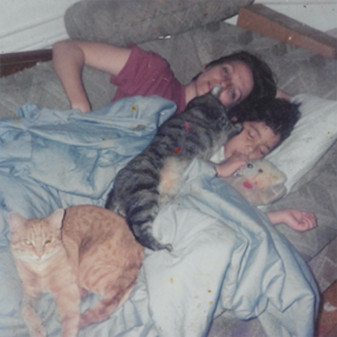
discovering she would eat delicatessen turkey. The orange male we
imagined as a red-headed German butcher and named Oscar. (At left
above, clockwise from bottom, are Oscar, Carola, Orko and Nina.)
Carola was very fond of Orko even though she liked to jump onto the
bed and block Mom's nostrils with a paw to wake her up. But in all her
multifelineous life, Carola has never met a cat she admired as much as
Oscar, and neither, obviously, have I--not only was he perceptive and
affectionate, nuts about mushrooms and good to his nutty sister, but
he would let you scratch his belly and then salute you by passing his
right paw over his eyes. The day we took him to the vet to be put down
at 18, I lifted his wasted body to the bed and scratched his belly and
he saluted me one last time. About two years later, a wobbly but still
exquisite Orko expired on the floor. Feeling we'd never top Oscar,
plus vacation sitters were getting harder to find, we've been catless
ever since. But in December of 2016, in the only good news I can
recall from that awful month, Nina took in brother-and-sister rescue
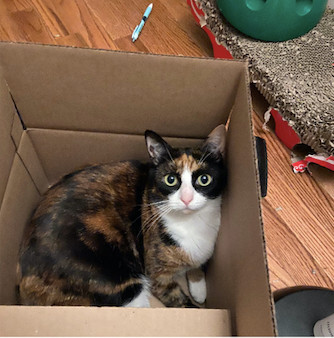
kittens: agile, brilliant calico Cinnamon (above, right) and big,
goofy, attention-craving tuxedo Kirk--the names they came in with,
though the Kirk-Enterprise pairing is notable. Nina has proven both a
fine portrait photographer and a devoted mother, once rescuing
Cinnamon from a fire escape a floor up in the dead of a rainy
night. Carola and I call them the grandchildren.
[Q] Starting with the Star Time box, the James Brown reissue program of the '90s was so revelatory and exciting so first let me thank you for turning me and I'm sure many others on to his amazing music which might not have gotten our attention otherwise as white boys. So my questions are why did you stop reviewing his albums in the late '90s (the last one you reviewed was his Say It Live and Loud concert) and do you recommend any of the four later releases (Dead on the Heavy Funk, Ballads, Love Power Peace, Funk Power 1970)? -- Ed Stephens, New York City
[A] At a certain point sorting out JB comps became too much work, especially since I had nowhere to write about them--my annual Xmas best-of roundup in the Voice had plenty of other fish to fry, and after I got canned there such detailed breakdowns weren't appropriate for the venues that were paying me. There was one partial exception, however: the James Brown obit essay I did for Rolling Stone Christmas week of 2006. That's reprinted in Is It Still Good to Ya? and hence embargoed until November of this year. But the credit line says "Substantially revised" for a reason--that essay was used as the basis for the rather different JB piece I wanted to preserve in my collection. Hence two discographical grafs were deleted from the RS piece, and for what they're worth, here they are:
Loving the box and two or three live ones, you'll wonder how to proceed. Many of the glorious reissues of JB's CD-era revival--Dead on the Heavy Funk, Roots of a Revolution, Soul Pride: The Instrumentals 1960-1969, Messin' With the Blues--are now available only used from usurers; the matched 1996 Foundations of Funk and Make It Funky double-CDs vary Star Time for fans who want funk to the exclusion of r&b and soul; most of the renowned In the Jungle Groove is also available in briefer form on the box, making it for serious students only even though Brown is the rare artist who improves with length. But the finest of the classic comps remains: 1988's Motherlode, where Cliff White exhumes the unreleased "Can I Get Some Help" and rescues the head-on nine-minute "People Get Up and Drive Your Funky Soul" from the Slaughter's Big Rip-Off soundtrack. The string syrup saturating much of the useful recent Ballads collection isn't ruinous, and soon enough Dave Matthews and Pee Wee Ellis chip in some funk and Brown has turned Porgy into a woman protecting a guy who's getting manhandled by the cops. The choicest of the many sidepeople collections is the thoroughly enjoyable Pass the Peas: The Best of the J.B.'s, which establishes that when James himself is announcing "Gotta have a funky good time," said good time seems incalculably more necessary. The only recent best-of I play is the second JB volume in Universal's budget Millennium Collection series--'70s masterpieces surrounding an embarrassing add-on called "Down and Out in New York City," it's perfect for vacation travel.
James Brown could be embarrassing, absolutely. Arrogant. Self-deluded. Coming up in an r&b business where the only way he could get King Records' Syd Nathan to cut Live at the Apollo was to pay for it himself, he inherited the hits-plus-filler theory of LP production, and the few JB studio albums that hold up as wholes are hard to find. So much of the superb There It Is has been recycled that it's hardly missed, but for the silly Hot Pants to pass to the usurers is a serious matter, and long-lost King product like Super Bad and Cold Sweat never reached CD outside of Japan. A few oddments remain, however. Gettin' Down to It, a what-the-?? piano-trio record from around the time of "The Popcorn" that transforms "Cold Sweat" into cocktail music and "Time After Time" into funk, will pique Ballads fans. The all-new material on 1998's I'm Back is pretty damn funky for a 65-year-old some say was 70. And then there's 1973's The Payback, which probably remains in print because hip-hoppers like its aura of blaxploitation, although Brown's revenge fantasy never made the flick it was written for.
[Q] A few months ago, there was a question here asking for your thoughts on ballad singers Dean Martin and Bobby Darin and you responded by saying you didn't care for either of them preferring Sinatra and many black pop singers starting with Nat King Cole. You've already written that your favorite Sinatra albums are Songs for Swinging Lovers and Nice 'n Easy so I'd like to ask where to start with the best Nat King Cole albums? -- Harry M, New York
[A]
First of all, I would definitely add to my Sinatra A list In the Wee
Small Hours and the late, deliberately creaky, self-selected old-man
compilation
Everything Happens to Me. As
for Cole, well, as with Clapton a while back whaddaya know? An essay
on Cole, written in 1992 and called "Across the Great Divide," leads
my highly non-online 1998 Harvard University Press collection
Grown Up All Wrong. You probably want two
Cole collections, one of the '40s piano hipster and one of the pop
smoothie nonetheless capable of 1948's surpassingly strange "Nature
Boy." For the hipster: Rhino's Jumpin' at Capitol or
conceivably the even jazzier Complete After Midnight
Sessions. For the great crooner: probably the much spottier 2001
double The Nat King Cole Story, which like 1998's The
Greatest Hits and 2005's The World of Nat King Cole I got
for free back in the good old days and can't advise offhand on
duplications etc. But one of each will certainly be a start.
[Q] You are a self-described fan of married life and the dynamics that go with it, which you relate in honesty and truth. As a newly married man myself, I enjoy reading on what's ahead, and am willing to get excited for the concept as I was willing to get excited about the music you so eloquently wrote about in the '70s CG columns. Is your appreciation of a musician's work colored by their domestic life? In particular, I think of Neil Young's recent spousal tumult (I believe he left his wife of many years for a much younger woman he met on the enviro-protest circuit), and I'd be interested to know if this and/or other things have colored your perception of his music. Of course, every person's choices are their own, but you're a critic by trade and surely such a staunch defender of marriage, however difficult the road, that you would have something to say. With best wishes to you and your wife. -- Robert, Prague, Czech Republic
[A]
This is a vast topic, so I'll try to keep my answer as brief as
practical. Recently I was asked to name
some
good marriage songs, and while Ashford & Simpson's "Is It
Still Good to Ya?" and I think Marshall Crenshaw's "Monday Morning
Rock" seem to have emerged from good marriages Etta James's remake of
Otis Redding's "Cigarettes and Coffee" almost certainly did not--read
her acerbic David Ritz as-told-to--and also, as I've indicated here,
neither in many respects did John Lennon's "Oh Yoko." Nonetheless,
Carola and I love them all equally as marriage songs, because the song
is one thing and the singer is another. In so many differing ways,
touring musicians do not lead lives conducive to domestic harmony, and
that some should hold long marriages together anyway is a tribute to
both the individuals and the institution. As for Young, he was married
to Pegi for a very long time; they brought up a disabled child
together. But Young is nonetheless an exceedingly eccentric and
willful man, and I very much doubt his marriage would be much of a
model for either you or me. It's also worth mentioning that his new
inamorata, dedicated environmentalist Darryl Hannah, was a legendary
blond bombshell actress in the '80s--famously gorgeous. But she's now
59. So at the very least this isn't one of those disgusting trading in
the old sexual partner on a brand new model things in which rich men
regularly indulge. P.S. You want good marriage music from a man, I
doubt you could to better than
Brad Paisley.
[Q] What do you think about Lady Antebellum and the Dixie Chicks changing their names in light of the George Floyd protests? -- Adam Montgomery, London
[A]
As a preamble, let me say that the heightened racial consciousness the
protests reflected and inspired is the most positive political
development in recent memory, perhaps the century depending on how the
tax-the-rich thing goes, and that these details are small
potatoes. That leaves me free to report that I've always considered
Lady Antebellum a dreadful band/group/entity whose Nashville schlock
was worthy of a name I've always considered a racist excrescence
designed to appeal to the worst impulses of the country audience. So
they changed their name 14 years too late, and then turned out to have
poached the new name from a Black artist. As long ago as June, they
were tweeting that this was all a misunderstanding, that "the hurt is
turning into hope," and the real Lady A, Black Seattle blues singer
Anita White, seemed to concur. Now it's August and the real Lady A
still awaits what she regards as a suitable cash settlement or another
name change by the schlocksters. Whatever she can wring out of the
guys with the overpaid lawyers won't be enough. As for the Dixie
Chicks, well, I don't want to get embroiled here in the endlessly
complex blackface minstrelsy matter, to which I devote some 8000 words
in
Book Reports. But if they think
just plain Chicks sounds better than Dixie Chicks--just aurally, sans
internal rhyme--their failure to write more good songs than we who've
rooted for them wished they would becomes easier to understand.
[Q] When you look at the current state of Kanye West's career, do you see any parallels with Bob Dylan in the 1980s? A period where another great artist embraced rather disturbing political/religious/cultural views that were more notable than the terrible and irrelevant records he was releasing. If so does that give you hope that in time Kanye will similarly rally as Dylan did in the 1990s? -- Josh Palmes, Stamford, Connecticut
[A]
No fucking way. Dylan's fleeting romance with Christianity was
infinitely less noxious morally. It was also fruitful musically where
West's "Christian" music is grandiose crap; if you'll look back at my
reviews you'll see that
Slow Train Coming was a B
plus, his best album by me since Blood on the Tracks. Moreover,
with the exception of his George Jackson song "George Jackson" and his
Rubin Carter song "Hurricane," Dylan's retreat from politics dated
back to the mid-'60s. His religiosity was nowhere near as pompous,
self-aggrandizing, and devoid of any recognizable moral compass as
West's, and he would never under any circumstances have been so
perverse as to embrace a fascist like Trump--unlike Neil Young, for
instance, he never even dallied with Ronald Reagan--or become so
addled he didn't know evil when he saw it. Anybody can change, and
West's musical genius is on the public record. But so is a megalomania
Dylan has never gotten near. He deserves to be stowed in a mental
hospital, period--preferably a public one in, say, West Virginia.
July 15, 2020
Grades that hold up (and one that didn't), lyrical determinacy (or not), Kendrick's minuses (and pluses), pleasant enough music, unpleasant mail and the eternal greatness of T.S. Monk's "Bon Bon Vie."
[Q] Are there some notable albums you had loved initially but in the process of time of time you think of them as much worse? You know, an A-, an A, or maybe even an A+ that has aged extraordinarily poorly; put out of context, there's not much left? -- Jakub, Olkusz, Poland
[A]
Basically the answer is no, although the way David Murray's A plus
Shakill's Warrior
failed to bowl me over when I checked it out a while back is an
exception--A plusses should be eternal, so I'd have to guess now that
that one is an A minus. The reason it's only "basically," however, is
that there are for sure some A minus albums out there that I haven't
played since I reviewed them--statistically, it's inevitable. I
wouldn't expect to immediately "get" every low A minus I haven't
played in 20 or 30 years, but I also wouldn't replay unless I had a
journalistic reason to do so even though it would only be fair to give
it a second try. In general, however, such experiments work out very
well--A minuses I literally haven't heard in two or three decades
sound fine when I bring them back. I remember doing that a year or two
back with two early-'70s albums by what I'd describe as black
bohemians who got very little critical attention:
Paul Pena in 1972 and
"Mississippi Charles" Bevel in
1973. After almost half a century both were still clearly A minuses by
me. Proud to say I seldom jump the gun or get carried away by either
the conventional wisdom or my own contrarian tendencies.
[Q] Hi Bob! Another one of your Chinese fans here, wanna thank you for your work, I started following when I was 12, now I'm 25 and your writing has pretty much formed my musical tastes and still is the never failing compass to exciting new (and old) music. So! As a non-native English speaker, I've always wondered what your approach to the comprehension of lyrics in more obscure and less accessible music is. Might as well throw in some of the hip-hop and folk music (Dylan?). As I understand it, you play the records a couple of times and delve into them when the music really grabs you. I doubt that you understand everything all the time, so at what point do you decide that you need to read them? Do you always wait until you understand everything before you grade the records? (All the slang and cultural references in hip-hop music!) And what do you do if you can't get hold of the lyrics? -- Jo, Nantes, France
[A]
As long as they're in English I always try to know what the lyrics are
at least in general before I sign off on a record, which always takes
more than a couple of times, and when they're not readily available I
poke around trying to get a rough idea. Many people, some of them
wonderful vocalists or otherwise gifted musicians, have really stupid
ideas about politics, religion, and human relations, and many men have
deplorable ideas about women. Not most, certainly, but for sure a few,
and if I'm signing off on music that includes such ideas I at the very
least want to be aware of it. Sometimes, of course, knowing the lyrics
is literally impossible, because they're garbled or gargled. But
Genius, which I refer to all the time, is a very useful if less than
absolutely accurate resource, and often interviews and reviews help
too. The lyrics aren't determinative and shouldn't be. The music
generally continues to dominate my aesthetic response, though there
are exceptions. But knowing what's there is just part of the job.
[Q] I'm probably grade-grubbing here, but you gave pretty much every Kendrick Lamar album an A-minus, which means there are some flaws holding it back from an A/A+. I'm curious to know what those flaws are--is it song-for-song inconsistency, or a general dislike for his ambitious concepts? And given that To Pimp a Butterfly came in 22nd on your best-of decade list (ahead of Modern Vampires, which got an A+) has your opinion changed? -- Oscar, Johannesburg, South Africa
[A]
Not grade-grubbing--a reasonable question, especially given
Butterfly's placement in my decade list, though if you look at the
Dean's List for 2015 (via the Pazz
& Jop tab on the
robertchristgau.com homepage) you'll see it's
number four there, because by year's end I'd already decided I'd
underrated it. My problem with Lamar has always been his flow. I've
just never gotten the kind of musical thrill from his soft-edged
enunciation that I do from crisper and clearer rappers: Chuck D,
Rakim, Jay-Z, Eminem, Nicki Minaj. Especially given that I made it a
point to defend Kanye's somewhat awkward flow when he was getting
dissed for it early in his tragic and increasingly reprehensible
career, this is obviously a personal quirk of mine, one I might
renounce altogether were I ever to spend a day or two bearing down on
Lamar. A major artist without question.
[Q] A lot of young people coming off of the musical line of Vampire Weekend, Sufjan Stevens, Beach House, and Mitski feel like (Sandy) Alex G stands out brightly in Spotify's indie playlists. What did you think of his September 2019 album House of Sugar? Too pleasant with not enough being said? -- Alan, Canada
[A]
I read those reviews and dutifully stuck the album up at the top of my
Spotify Consumer Guide candidates, of which there are a lot. Assumed
that I'd put it on now and then and eventually it would hook on
between my ears the way all the artists you've named did after
three-four-five plays--if not worth a full review, then at least what
I still think of as an Honorable Mention. Didn't happen, so after a
month or so I gave up. "Too pleasant without enough being said" may
well be the reason--I note that the four artists you named all have
both distinctly different sounds and lyrical approaches, the latter of
which Alex G definitely does not.
[Q] Was looking through your grades recently (as one does with way too much free time on their hands) and was curious about your opinions on any Swans album past Filth (1983)? You gave it a B+, so I'd generally imagine you don't dislike their sound or their vibe in general. Or maybe on a broader topic: any strong opinions on Gira's work outside of the group? (Referring his solo work, Angels of Light, The World of Skin, or The Body Lovers / The Body Haters.) Can't really imagine you being a fan of the super heavy stuff, but thought I would ask anyway. -- Paul Attard, New York
[A]
Sometimes in the late '80s, after I'd published a few derogatory words
about Swans in contexts I no longer recall--possibly Voice Choices or
something?--I got a letter from Michael Gira or someone claiming to be
Michael Gira with a hand-written message explaining that the gluelike
residue on the paper was Gira's semen and a few of his pubic hairs. By
this time I'd decided that Swans weren't as funny as my B plus said
they were, so I was convinced by this missive never to listen to them
again. In fact, however, I did, early in this decade; don't remember
which latish Swans album the Pitchfork boys got so exercised about,
but I played it more than once and decided I'd done my duty. I can't
say I was surprised when a few years ago singer Larkin Grimm
accused Gira of raping her.
[Q] I fucking love "Bon Bon Vie." I mean, how could you not? This is an amazing song that deepens every time you listen to it. I'm just curious to know, considering how much you love Monk, do you think that the fact that it was made by two of his children influenced how much you love that song purely musically? -- Nicholas Auclair, Montreal
[A] Seems to me my CG album review answers the Thelonious question. But since you've given me this opening, I'm grabbing the chance to point out that the final chapter of my Going Into the City memoir is entitled "Bon Bon Vie" and includes the following paragraph:
T.S. Monk's "Bon Bon Vie" had no connection to Thelonious Monk except a big one--Monk's son, bandleader Thelonious Sphere Monk III a/k/a Toot, plus his sister Boo Boo and his fiancee Yvonne Fletcher. Their 1980 debut album was produced by Sandy Linzer, a veteran songwriter with enough catalog highlights to keep a hack's head up--the Toys' "Lover's Concerto," the Four Seasons' "Workin' My Way Back to You," Odyssey's "Native New Yorker"--who had also recently produced Dr. Buzzard's Original Savannah Band, the rare artistic entity (cf. the Pointer Sisters) to claim retro and make something more alive out of it. But not even Dr. Buzzard put such a spin on "the good life." "Bon Bon Vie" engineers its escape by devoting three stanzas to Toot's clock-punching weariness and alienation, one to how much he loves New York anyway, and one to a champagne-quaffing night on the town, the final line of which leaves his last remaining dime in a blind man's cup. Yet in all five stanzas the Chic-like spritz of Toot's arrangement and the good-humored ebullience of his vocal--an excellent drummer by trade, he can sing when he has a song, including a 1999 "Just a Little Lovin'" almost as sexy as Dusty Springfield's--exemplify a Gramsci precept Marshall Berman loved: "pessimism of the intellect, optimism of the will." Linzer never gave the band another decent song. And then, in a Marshall Berman-worthy turn, both Boo Boo Monk and Yvonne Fletcher died of breast cancer in 1984. After a period of seclusion, Toot emerged to head Boo Boo's brainchild, the long-running Thelonious Monk Institute of Jazz. He also started a pretty good jazz group. But even rearranging his father's indelible book, he never came up with anything as complex and distinguished as "Bon Bon Vie."
June 17, 2020
Book picks, David Murray and Prince grades, singing with the brain, the two best albums never reviewed, and you say you want a revolution . . .
[Q] I haven't had the chance to buy Book Reports yet, but I was curious to know if you recommend any biography on Ella Fitzgerald, Miles Davis, Frank Sinatra, George Clinton, or Public Enemy or a book on New Orleans music. -- Nicolas Auclair, Montreal
[A]
As you and I know, this question was simply the tag end of a long
paean praising the first volume of Gary Giddins's superb
two-volumes-so-far Bing Crosby biography and recommending some Crosby
recordings on Spotify that I'll try to get to sometime. And as some
may recognize, you are a frequent correspondent here, so much so that
I'm rather shocked that you haven't yet purchased
Book Reports. I will however name as you
request other worthy books. Can't help on Ella and oddly enough don't
know of a good P-Funk book; my records indicate that I read the David
Mills oral history but I don't remember a thing about it. The Chuck D
as-told-to Fight the Power has some jam. My favorite Miles
Davis book is John F. Szwed's sharp and often alarming So What,
although Ian Carr and Quincy Troupe, both of whom I've only looked at,
are more renowned. James Kaplan's two volumes add up to the standard
Frank Sinatra tome, but you could also read War and Peace
instead. I admit to enjoying Kitty Kelley's scandal-mongering His
Way, which is not to swear there's a true word in it; the Pete
Hamill quickie Why Sinatra Matters has its virtues. New Orleans
is different. I've only read in rather than through Jeff Hannusch's
I Hear You Knockin' and Jason Berry et al's Up From the
Cradle of Jazz but admire both, and recommend two biographies:
Rick Coleman's Fats Domino and John Wirt's Huey Smith -- much of it's
devoted to his lifelong fight to get his royalties, which proves a
compelling and touching story. I also love love love the Ned Sublette
memoir The Year Before the Flood: A Story of New Orleans.